



簡易斑點偵測器
(已停產)
先進表面檢測技術應用於電池、紙張、薄膜或玻璃產業。
- 偵測微弱缺陷與污染物,即使在雜訊影像中亦能實現
- 快速處理以支援線上檢測
- 相容於線掃描與2D相機的影像擷取
- 可選配零件邊緣區域的預對齊功能
- 可選配深度學習缺陷分類技術
- 提供簡易且全面的C++、C#與Python API介面
描述
即時處理技術應用於在線表面檢測
憑藉其兩階段處理架構,EasySpotDetector 的運算速度超越其他基於深度學習的物體分割處理方案。在 Intel i7-10850H 處理器的電腦上,EasySpotDetector 每秒可處理高達 200 百萬像素(僅檢測階段)。分類任務雖能透過 GPU 運算提升效能,但憑藉 OpenVINO 技術,其運算流程亦針對 CPU 執行進行了優化。
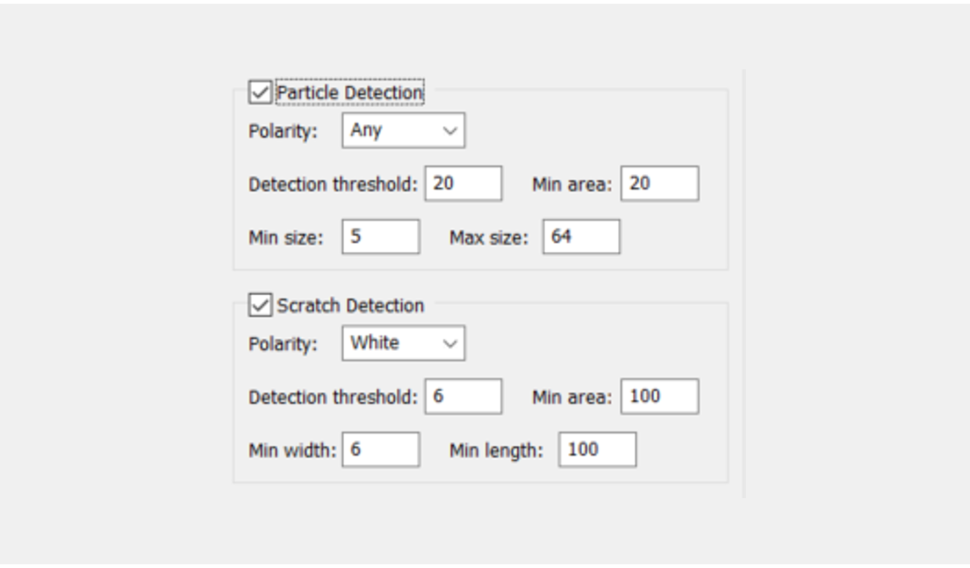
控制缺陷分割的參數集
一組明確參數可讓使用者鎖定特定缺陷。可調整缺陷的類型(顆粒、刮痕等)、外觀(較淺、較深或兩者皆有)、尺寸,以及最低對比度(明顯或微弱缺陷)。
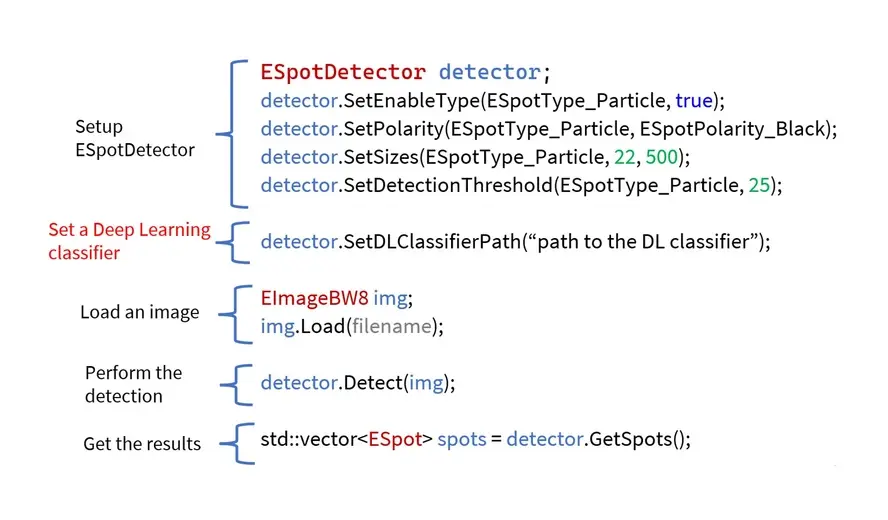
簡易且全面的 API
EasySpotDetector 提供單一 API,用於對齊感興趣區域 (ROI)、檢測表面缺陷,以及透過自訂訓練的深度學習分類器進行分類。
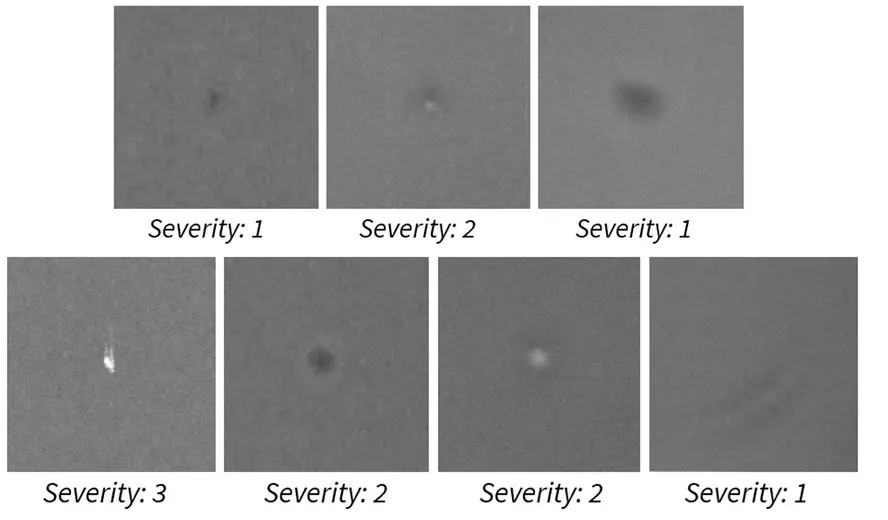
客製化訓練的深度學習物件分類器
偵測到的物件可提交至深度學習分類器。該分類器由使用者透過簡易操作的深度學習工作室進行訓練,專為其特定應用場景量身打造。分類器的潛在用途包括:
- 確認或否定檢測到的候選物件。
- 評估缺陷的嚴重程度等級。
- 依據物體外觀特徵將檢測結果劃分為多個類別。

經多種使用情境測試
EasySpotDetector 已成功應用於多種表面檢測領域,包括:電池箔片、織物、鋼材、被動電子元件,以及天然材質(例如:皮革、木材)。
EasySpotDetector 示意圖
開啟 eVision Studio
可透過圖形化介面設計複雜的影像處理流程。這套工具集展現了 Open eVision 函式庫的多樣性與功能。 系統會自動產生對應於處理流程的 C++、Python 及 C# 原始碼,並提供 Open eVision API 的互動式文件。Open eVision Studio 可處理即時影像來源,例如 GigE Vision 攝影機、Coaxlink 幀擷取卡或 eGrabber 錄影機序列。
此應用程式完全免費,可在 Windows、Linux 系統上運行,並相容於 Intel 及 ARM 64 位元架構。


Software
- Host PC Operating System
-
Supported operating systems:
Microsoft Windows 11, 10 for x86-64 (64-bit) processor architecture
Microsoft Windows 11, 10 IoT Enterprise for x86-64 systems
Linux for x86-64 (64-bit) and ARMv8-A (64-bit) processor architectures with a glibc version greater or equal to 2.18
Minimum requirements:
8 GB RAM
Optional NVidia GPU
- APIs
-
Supported programming languages :
The Open eVision libraries and tools support C++, Python and the programming languages compatible with the .NET (C#, VB.NET)
C++ requirements: A compiler compatible with the C++ 11 standard is required to use Open eVision
Python requirements: Python 3.11 or later is required to use the Python bindings for Open eVision
.NET requirements: .NET framework 4.8 (or later) or the .NET platform 6.0 (or later) are supported
Supported Integrated Development Environments:
Microsoft Visual Studio 2017 (C++, C#, VB .NET, C++/CLI)
Microsoft Visual Studio 2019 (C++, C#, VB .NET, C++/CLI)
Microsoft Visual Studio 2022 (C++, C#, VB .NET, C++/CLI)
QtCreator 4.15 with Qt 5.12
- Input
-
Image source:
Any 8-bit grey scale image, no size limit
Region of interest:
Explicit or automatic selection of the region of interest (an oriented rectangle is fitted to the part’s edges)
- Output
-
A list of detected spots with their type (particle or scratch), position and size, strength, and pixel level segmentation map
Optionally, if a deep learning classifier is loaded, a class and a probability is set for each spot. The deep learning classifier is a trained EasyClassify tool.
Display functions are provided to draw the spot bounding boxes and segmented pixel
- Performance
-
Processing speed on single core Intel i7-10850H:
Particle detection only: 200 MPixels/s
Particle and scratch: 60 MPixels/s
- Requirements
-
Minimum defect size:
2x2 pixels
No maximum defect size
Ordering Information
- Product status
-
Released
- Product code - Description
-
PC4190 Open EasySpotDetector for USB dongle
PC4340 Open eVision EasySpotDetector
- Related products
-
PC6512 eVision/Open eVision USB Dongle (empty)
PC6514 Neo USB Dongle (empty)